STL Diesel Frequently Asked Questions
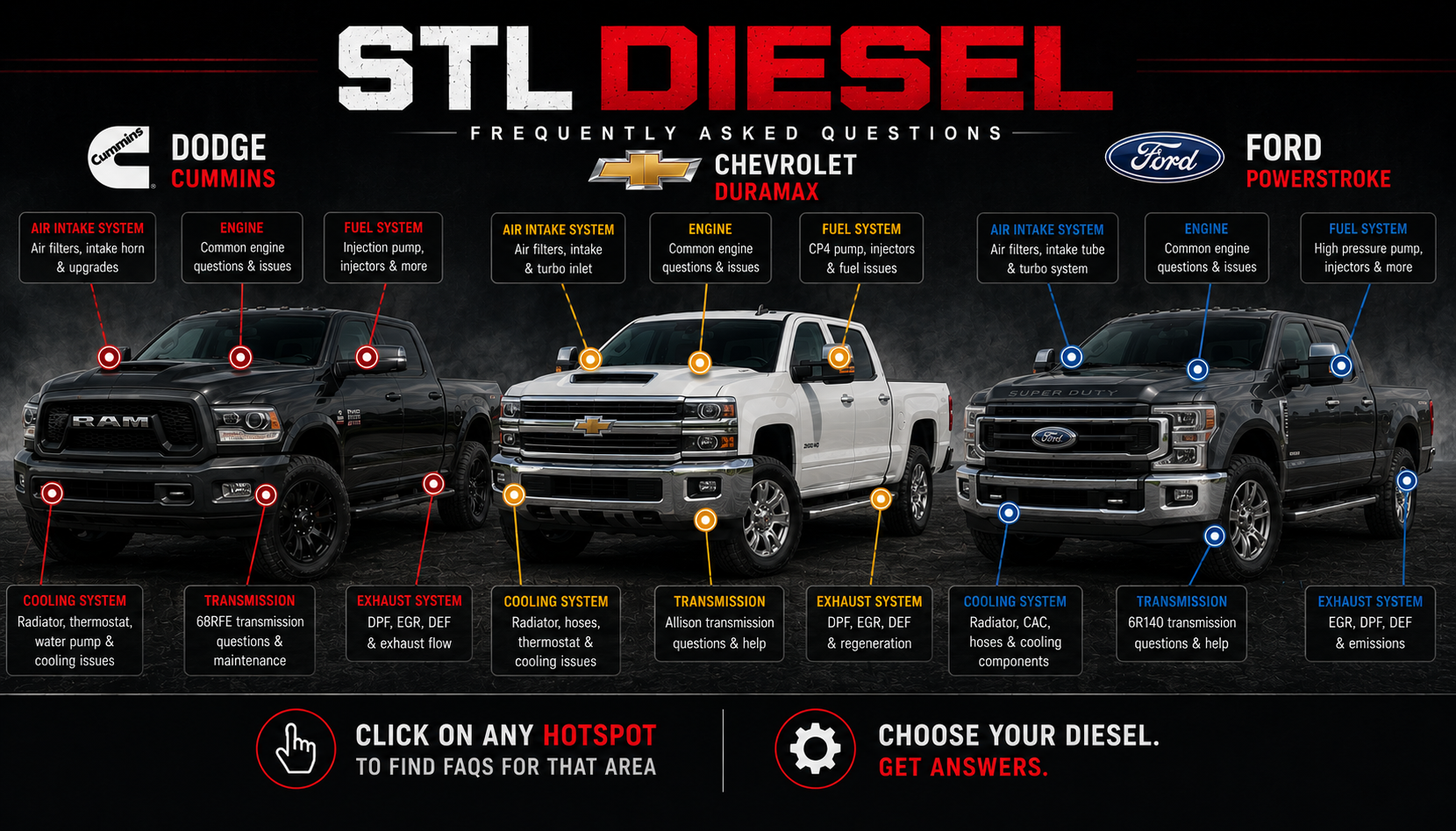
STL DIESEL KNOWLEDGE CENTER
Choose your truck and system
Searchable Diesel Knowledge Base
All Power Stroke, Cummins & Duramax Questions
Use the interactive truck above, or expand any answer below. These answers are published in the page HTML so customers and search systems can read the same information.
Ram Cummins
Air Intake System
How often should I replace the air filter on my Cummins?
Inspect the filter at every oil service and replace it when it is dirty, damaged, or restricted. Dusty roads, construction sites, farm use, and frequent towing can shorten its service life, so the exact interval should follow the truck’s maintenance schedule and operating conditions.
What are the signs of a restricted or clogged air filter?
Common signs include reduced power, slower turbo response, lower fuel economy, excessive smoke, or an air-filter restriction warning. These symptoms can also come from boost leaks or sensor problems, so the intake system should be inspected before replacing parts.
Will an aftermarket cold-air intake improve performance?
A quality intake may reduce restriction and increase induction sound, but gains on an otherwise stock truck are often modest. The system must seal correctly, filter well, and remain compatible with the mass-airflow and emissions systems.
Can an intake leak cause low power or excessive smoke?
Yes. A leak between the air filter, turbocharger, charge-air cooler, or intake manifold can reduce boost and upset the air-to-fuel balance, causing low power, smoke, or underboost codes.
Why is my Cummins making a whistling or sucking noise?
Some turbo whistle is normal, especially under load. A new or unusually loud noise can indicate a loose clamp, split intake boot, leaking charge-air cooler, damaged airbox, or turbocharger concern and should be checked before heavy towing.
Engine
Why is my Cummins engine losing power?
Power loss can come from restricted fuel or air supply, boost leaks, injector problems, turbocharger faults, emissions-system restrictions, or a transmission issue. A proper diagnosis should include a scan, fuel-pressure checks, boost data, and a visual inspection.
What causes excessive blow-by in a Cummins engine?
Some crankcase vapor is normal, but heavy pulsing smoke or oil mist can indicate worn piston rings, cylinder damage, excessive cylinder pressure, or a restricted crankcase ventilation system. A crankcase-pressure or compression-related test can help determine severity.
Why is my Cummins knocking, ticking, or running rough?
Possible causes include injector imbalance, valvetrain wear, exhaust leaks, fuel contamination, low rail pressure, or internal engine damage. Because diesel combustion noise can hide serious problems, a new knock or rough-running condition should be diagnosed promptly.
What are the signs of a head-gasket problem?
Warning signs can include unexplained coolant loss, pressure in the cooling system soon after a cold start, overheating, coolant pushed from the reservoir, white exhaust smoke, or combustion gases in the coolant. Testing is needed because EGR-cooler and other cooling-system faults can look similar.
How often should the engine oil and filter be changed?
Use the interval and oil specification listed for the truck’s model year and duty cycle. Frequent idling, towing, short trips, dusty operation, or high engine hours may require a shorter severe-service interval.
Why is my Cummins difficult to start when cold?
Cold-start problems may be caused by weak batteries, slow cranking speed, grid-heater faults, fuel drain-back, low rail pressure, injector leakage, poor fuel quality, or low compression. Battery and starting-system tests are usually the best first step.
Fuel System
What are the symptoms of failing Cummins injectors?
Symptoms may include hard starting, rough idle, excessive smoke, fuel knock, poor fuel economy, low power, high return flow, or abnormal cylinder-balance data. Injector testing is important because low fuel supply or compression problems can cause similar symptoms.
How do I know whether my CP3 or CP4 injection pump is failing?
Long crank, low rail-pressure codes, stalling, metal contamination, or failure to build commanded pressure can point toward the high-pressure pump. Diagnosis should also verify lift-pump supply, filters, pressure-regulator operation, and injector return rates.
Why is my Cummins experiencing low fuel-rail pressure?
Potential causes include a restricted fuel filter, weak lift pump, air entering the supply side, a pressure-control fault, excessive injector return, or a worn high-pressure pump. Actual and commanded rail pressure should be compared under the conditions that set the fault.
Can contaminated fuel damage the injectors or injection pump?
Yes. Water, gasoline, dirt, rust, or other contamination can quickly damage precision high-pressure components. Stop driving if misfueling or heavy contamination is suspected and have the system sampled before further operation.
How often should Cummins fuel filters be replaced?
Follow the model-year maintenance schedule and use the correct filter quality. Trucks exposed to questionable fuel, heavy towing, long idle time, or cold-weather waxing may need more frequent inspection or replacement.
Why does my truck have a hard start or long crank?
A long crank can result from low cranking voltage, fuel drain-back, restricted filters, weak supply pressure, excessive injector return, low rail pressure, sensor faults, or compression loss. Scan data during cranking helps narrow the cause.
Cooling System
Why is my Cummins overheating while towing?
Towing adds heat load, so overheating may expose a dirty radiator stack, restricted coolant flow, weak fan clutch, thermostat problem, failing water pump, low coolant, or excessive engine load. The radiator, condenser, and charge-air cooler should be checked for internal and external restriction.
What are the signs of a failing water pump?
Look for coolant leakage from the pump area, bearing noise, pulley movement, overheating, or poor coolant circulation. Some pumps can fail internally without an obvious external leak.
Why is coolant disappearing without a visible leak?
Coolant may be leaking only when hot, entering the engine or exhaust system, escaping through the reservoir cap, or collecting in a hidden area. Pressure testing, dye inspection, and combustion-gas testing may be needed.
When should the thermostat be replaced?
Replace it when testing shows it is stuck open, stuck closed, opening at the wrong temperature, or causing unstable operating temperature. Use the correct thermostat because diesel calibration and warm-up behavior depend on it.
How often should the cooling system be serviced?
Follow the coolant type and interval specified for the truck’s year, and test coolant condition between services. Mixing incompatible coolant, using untreated water, or ignoring additive condition can cause corrosion and deposits.
Can a clogged radiator or charge-air cooler cause overheating?
Yes. External debris between the cooling-stack components can block airflow, while internal deposits can reduce coolant flow. A restricted charge-air cooler can also increase intake temperature and engine load.
68RFE Transmission
What are the common problems with the 68RFE transmission?
Common concerns include harsh or delayed shifts, clutch slip, valve-body wear, pressure-control problems, converter shudder, overheating, and limp mode. Early diagnosis can sometimes prevent a smaller hydraulic or electrical issue from becoming a full rebuild.
Why does my Ram shift hard, slip, or hesitate?
Low or degraded fluid, incorrect fluid level, adaptive values, solenoid or valve-body faults, clutch wear, speed-sensor problems, or engine-torque issues may be involved. Codes, live data, fluid condition, and line-pressure information should be checked.
How often should the transmission fluid and filters be changed?
Use the factory interval for the truck’s year and duty cycle, with shorter service intervals for towing, commercial use, heat, or frequent stop-and-go driving. The 68RFE requires the correct fluid and filter setup.
Can additional horsepower damage the stock transmission?
Yes. Added torque can exceed clutch, converter, input-shaft, and line-pressure capacity, especially during towing or aggressive low-rpm acceleration. Tuning should be matched to the transmission’s condition and supporting upgrades.
Why is my transmission temperature running high?
Possible causes include heavy load, low fluid, converter slip, restricted cooler flow, cooling-system problems, or internal clutch wear. Continued overheating shortens fluid and clutch life, so the cause should be corrected.
When should I consider rebuilding or upgrading my 68RFE?
A rebuild may be needed for persistent slip, excessive clutch material, loss of gear, repeated limp mode, or confirmed internal damage. Upgrade level should match the truck’s power, tire size, towing load, and intended use.
Exhaust & Emissions
Why does my Cummins keep going into regeneration?
Frequent regeneration can be caused by short trips, excessive idling, low exhaust temperature, engine over-fueling, boost leaks, sensor faults, or a DPF that is becoming restricted. The root cause should be corrected rather than repeatedly forcing regeneration.
What causes DPF, EGR, or DEF warning messages?
These warnings can come from soot loading, temperature or pressure sensor faults, EGR flow problems, DEF quality or delivery faults, NOx-sensor issues, wiring damage, or an engine problem that increases emissions. Fault codes and test results are needed to identify the system at fault.
Why is my truck showing a “Service DEF System” warning?
The system may detect poor DEF quality, a frozen or failed pump or heater, blocked injector, pressure problem, NOx-sensor fault, SCR-efficiency issue, or wiring concern. Continued driving can trigger a speed limitation, so the warning should be diagnosed promptly.
What causes a Cummins to enter reduced-power mode?
Reduced power protects the engine or emissions system when the computer sees a serious fault. Common triggers include low fuel pressure, overheating, boost-control faults, DPF restriction, DEF/SCR failures, or sensor readings outside safe limits.
How do I know whether the DPF is clogged?
Signs include frequent regens, reduced power, high exhaust backpressure, poor fuel economy, warning messages, or soot-load codes. A scan tool can evaluate calculated soot load and differential pressure before cleaning or replacement is recommended.
Can short trips cause diesel emissions-system problems?
Yes. Repeated short trips may prevent the exhaust from reaching the temperature needed to complete regeneration, allowing soot and moisture to accumulate. Periodic fully warmed operation helps, but an active warning or fault should not be ignored.
Chevrolet / GMC Duramax
Air Intake System
How often should I replace the air filter on my Duramax?
Inspect it during routine service and replace it when dirty, damaged, wet, or restricted. Severe dust, farm use, construction work, and off-road operation can require more frequent service than the normal schedule.
Can a restricted air filter cause low boost or reduced power?
Yes. Restricted airflow can slow turbo response, reduce power, increase smoke, and contribute to airflow or underboost codes. The entire intake path should be checked because a collapsed duct or dirty sensor can create similar symptoms.
What are the signs of a leaking intake tube or intercooler boot?
Common signs include a hiss under load, oily residue around a connection, low boost, sluggish acceleration, smoke, or underboost codes. Pressure or smoke testing can locate leaks that are difficult to see.
Will an aftermarket intake improve Duramax performance?
A properly designed intake can reduce restriction and change intake sound, but large gains are unlikely on a stock calibration. Filtration quality, sensor placement, heat shielding, and sealed connections matter more than filter size alone.
Why does my Duramax make a loud hissing or whistling noise?
Normal turbo sound can become louder with load, but a sudden change may indicate a split charge pipe, loose clamp, leaking intercooler, exhaust leak, or turbo-control issue. Inspect it before towing or continuing hard acceleration.
Engine
Why is my Duramax running rough or misfiring?
Possible causes include injector imbalance, fuel-pressure problems, glow-plug or compression issues, wiring faults, air in the fuel, or internal engine damage. Cylinder contribution data and fuel-system tests help identify the affected cylinder or system.
What causes excessive crankcase pressure or blow-by?
Heavy blow-by can result from ring or cylinder wear, piston damage, excessive cylinder pressure, or a restricted crankcase ventilation path. A warm-engine crankcase-pressure test is more useful than judging vapor by sight alone.
Why is my Duramax losing coolant?
Possible sources include hoses, radiator, water pump, reservoir cap, heater core, EGR cooler on applicable models, or an internal engine leak. Cooling-system pressure and combustion-gas tests help separate external from internal loss.
What are the signs of a Duramax head-gasket failure?
Potential signs include firm upper radiator hoses soon after a cold start, unexplained coolant loss, coolant pushed from the reservoir, overheating under load, or combustion gases in the cooling system. Similar symptoms can come from other faults, so testing is essential.
Why does my Duramax have low oil pressure?
Low oil level, incorrect or diluted oil, a faulty sender, filter problems, pump or pickup issues, bearing clearance, or internal leakage may be responsible. Mechanical pressure should be verified before condemning the engine.
How often should I change the engine oil and filter?
Follow the model-year oil-life system and maintenance schedule, using the required diesel-rated oil. Towing, idling, short trips, high engine hours, and extreme temperatures may justify earlier service.
Fuel System
What are the symptoms of failing Duramax injectors?
Symptoms can include rough idle, haze or smoke, fuel knock, hard starts, excessive return flow, oil dilution on some failures, poor economy, or abnormal balance rates. Proper testing should confirm the injector before replacement.
What happens when a CP4 injection pump fails?
A severe CP4 failure can send metal through the rails, injectors, lines, and tank-return circuit, contaminating much of the fuel system. Stop cranking if metal contamination is suspected because continued operation can increase damage.
Can a CP4 fuel system be converted to a CP3 system?
Conversion options exist for some applications, but legality, emissions compliance, calibration, parts quality, and warranty implications must be considered. The correct solution depends on the exact year, engine, and how the truck is used.
Why is my Duramax showing low fuel-rail pressure?
A restricted filter, air leak, weak supply, pressure-regulator fault, excessive injector return, pump wear, or contaminated fuel can cause low pressure. Commanded versus actual pressure should be reviewed during cranking and under load.
How often should the Duramax fuel filter be changed?
Use the interval specified for the truck and replace it sooner if restriction, water contamination, poor fuel quality, cold-weather issues, or heavy-duty operation is present. Always prime and check for leaks after service.
Can contaminated fuel damage the entire fuel system?
Yes. Water, gasoline, dirt, rust, or metal debris can damage high-pressure components with very small internal clearances. A fuel sample and contamination inspection should be performed before parts are replaced.
Cooling System
Why does my Duramax overheat while towing?
Likely causes include debris packed in the cooling stack, weak fan operation, low coolant, thermostat or water-pump problems, restricted coolant flow, or excessive engine load. Towing data and cooling-stack inspection are especially important.
What are the signs of a failing Duramax water pump?
Coolant leakage near the pump, bearing noise, pulley movement, overheating, or poor circulation may indicate failure. Some pumps leak only when hot or under pressure.
Why is coolant being pushed out of the reservoir?
The system may be overheating, overfilled, unable to hold pressure, or receiving combustion pressure from an internal leak. A failed cap can also cause venting, so pressure and gas testing should be performed.
How often should Duramax coolant be replaced?
Follow the model-year schedule and use a coolant that meets the required specification. Coolant concentration, freeze protection, acidity, contamination, and mixed coolant types should be checked during service.
Can a dirty radiator stack cause high engine temperatures?
Yes. Dirt, insects, oil residue, and debris can collect between the condenser, charge-air cooler, and radiator where it is not easily visible. Proper cleaning requires access without damaging the fins.
Why is the engine fan running loudly or constantly?
The fan may be responding normally to high coolant, transmission, intake-air, or air-conditioning load. If it stays engaged when temperatures are normal, the fan clutch, sensors, wiring, or calibration should be checked.
Allison Transmission
How often should an Allison transmission be serviced?
Use the interval and approved fluid listed for the exact Allison model and duty cycle. Towing, commercial use, heat, and frequent stop-and-go operation can shorten the appropriate service interval.
Why is my Allison transmission shifting hard?
Hard shifts may result from low or degraded fluid, adaptive learning, speed-sensor or wiring faults, valve-body wear, solenoid problems, engine-torque issues, or internal clutch damage. Codes and shift data should be reviewed first.
What causes an Allison transmission to enter limp mode?
Limp mode is triggered when the controller sees a fault that could damage the transmission. Electrical problems, speed-sensor faults, pressure-control issues, excessive slip, low voltage, or internal failure may be involved.
Why does the transmission slip under acceleration?
Low fluid, converter slip, worn clutches, hydraulic leakage, valve-body problems, or excessive engine torque may cause slipping. Continued driving while it slips can rapidly increase internal damage.
Is the stock Allison transmission safe with added horsepower?
Its capacity depends on model, condition, calibration, tire size, torque delivery, and use. Added low-rpm torque and heavy towing can exceed clutch or converter capacity even when casual driving feels normal.
What are the signs that my Allison transmission needs repair?
Warning signs include delayed engagement, flare between gears, repeated limp mode, shudder, burnt fluid, metal or clutch debris, loss of a gear, overheating, or confirmed excessive slip. Diagnosis determines whether the problem is external, hydraulic, electrical, or internal.
Exhaust & Emissions
Why does my Duramax perform frequent regenerations?
Short trips, idling, boost leaks, injector or airflow problems, temperature-sensor faults, EGR issues, or a restricted DPF can increase soot production or prevent a complete regeneration. The regeneration history and engine data should be reviewed.
What causes P20EE and other SCR-efficiency codes?
Possible causes include poor DEF quality, DEF dosing problems, exhaust leaks, failed NOx or temperature sensors, wiring faults, or an SCR catalyst that is not converting NOx efficiently. The system must be tested before replacing the catalyst.
Why does my truck display a “Service Emission System” warning?
The warning may relate to DPF, EGR, DEF delivery, NOx sensors, exhaust-temperature sensors, SCR performance, or engine conditions that raise emissions. The stored codes provide the starting point for diagnosis.
What are the signs of a clogged DPF?
Frequent or failed regens, rising differential pressure, reduced power, poor economy, high exhaust temperature, and soot-load warnings can indicate restriction. Physical ash accumulation and active engine faults must be distinguished from temporary soot loading.
Why is my Duramax using too much DEF?
Consumption rises with load and fuel use, but abnormal usage can result from leaks, over-dosing, inaccurate level readings, sensor faults, or SCR-efficiency problems. Check for crystallization and compare commanded dosing with operating conditions.
What causes a Duramax to enter reduced-power mode?
The controller may limit power for overheating, low fuel pressure, turbo-control faults, DPF restriction, DEF/SCR problems, or other serious engine and emissions faults. Address the cause quickly because some emissions faults can lead to speed limitation.
Ford Power Stroke
Air Intake System
How often should I replace the air filter on my Power Stroke?
Inspect it during routine service and follow the model-year maintenance schedule. Dusty roads, farm work, construction environments, and off-road use can make earlier replacement necessary.
Can a dirty air filter cause reduced power or low boost?
Yes. A restricted filter or intake duct can limit airflow, reduce turbo response, and contribute to airflow or underboost faults. Sensor contamination and charge-air leaks should also be considered.
What are the signs of a leaking intercooler pipe or boot?
A hiss or whoosh under load, oily residue at a joint, low boost, smoke, poor acceleration, or an underboost code can indicate a leak. A pressure or smoke test is the most reliable way to find small leaks.
Why does my Power Stroke make a hissing noise under acceleration?
A small amount of turbo and airflow noise can be normal, but a new loud hiss may come from a loose clamp, split charge pipe, leaking intercooler, exhaust leak, or turbo-control problem. Avoid heavy load until it is inspected.
Will an aftermarket intake improve performance or fuel economy?
A well-designed system may reduce restriction and change sound, but fuel-economy and power gains on a stock truck are usually limited. Good filtration, sealed plumbing, and correct sensor behavior are essential.
Engine
Why is my Power Stroke running rough or misfiring?
Possible causes include injector or fuel-pressure problems, glow-plug issues, compression loss, wiring faults, air in the fuel, EGR concerns, or valvetrain damage. Cylinder contribution and fuel-system testing help avoid unnecessary parts replacement.
What causes excessive blow-by in a Power Stroke engine?
Heavy crankcase pressure can be caused by ring or cylinder wear, piston damage, excessive combustion pressure, or a restricted crankcase ventilation system. Testing crankcase pressure at operating temperature provides a better assessment than visual vapor alone.
Why is my Power Stroke losing coolant?
Leaks may come from hoses, radiator, water pump, reservoir, heater core, EGR cooler on applicable engines, or an internal engine leak. Pressure testing and inspection under hot and cold conditions may be required.
What causes ticking, knocking, or rattling engine noises?
Potential sources include injectors, valvetrain, exhaust leaks, accessory drives, fuel quality, low oil pressure, turbo hardware, or internal engine damage. A new knock that follows engine load should be checked promptly.
Why is my Power Stroke difficult to start?
Weak batteries, slow cranking, glow-plug faults, low fuel pressure, air intrusion, injector problems, high-pressure oil-system issues on applicable engines, sensor faults, or low compression may be involved. Cranking data helps narrow the system.
How often should the engine oil and filter be changed?
Follow the oil-life monitor and maintenance schedule for the exact engine, using oil that meets Ford’s required specification. Towing, extended idling, short trips, and high engine hours can require earlier service.
Fuel System
What are the symptoms of failing Power Stroke injectors?
Symptoms can include hard starting, rough idle, smoke, fuel knock, low power, poor economy, abnormal contribution data, or excessive return flow. Fuel supply, compression, and wiring should be verified before replacing injectors.
What happens when the high-pressure fuel pump fails?
The engine may crank without starting, stall, lose rail pressure, or set pressure-related faults. On systems that shed metal, contamination can spread through the rails and injectors, so further cranking should be avoided if metal is found.
Why is my Power Stroke showing low fuel-rail pressure?
Restricted filters, weak low-pressure supply, air leaks, pressure-regulator faults, injector return leakage, contaminated fuel, or a worn high-pressure pump can cause the condition. Commanded and actual pressure should be compared during the failure.
Can contaminated fuel damage the high-pressure fuel system?
Yes. Water, gasoline, dirt, rust, or other contamination can damage pumps and injectors very quickly. A sample should be taken and the full system inspected before deciding on the repair scope.
How often should both Power Stroke fuel filters be changed?
Use the factory schedule for the model year and replace both filters as a set when required. Poor fuel quality, water contamination, heavy use, or restriction warnings can justify earlier service.
Why does my truck crank for a long time before starting?
Possible causes include weak batteries, slow cranking, fuel drain-back, restricted filters, low supply or rail pressure, excessive injector return, sensor faults, glow-plug problems, or compression loss. Scan data during cranking is very helpful.
Cooling System
Why is my Power Stroke overheating while towing?
Heavy load can expose a dirty cooling stack, weak fan operation, low coolant, thermostat or water-pump faults, restricted coolant flow, or an engine problem creating extra heat. Cooling-system and transmission temperatures should be reviewed together.
What are the signs of a failing water pump?
Look for coolant leakage, bearing noise, pulley movement, overheating, or poor circulation. Some pump failures occur internally and may not leave a large visible leak.
Why is coolant leaking around the radiator or reservoir?
Common sources include hose connections, radiator seams, degas-bottle cracks, the pressure cap, overflow from overheating, or excessive cooling-system pressure. A pressure test can reveal leaks that appear only when hot.
How often should Power Stroke coolant be serviced?
Follow the exact coolant specification and interval for the engine and model year. Coolant condition, concentration, contamination, and additive requirements should be checked because mixing products can create deposits or corrosion.
Can a restricted radiator or charge-air cooler cause overheating?
Yes. External debris reduces airflow, internal radiator deposits reduce coolant flow, and a restricted charge-air cooler can increase intake temperature and engine load. The full stack must be inspected, not just the front surface.
Why is the cooling fan running loudly or frequently?
The fan may be responding to high coolant, transmission, intake-air, or air-conditioning pressure. If it remains engaged at normal temperatures, the clutch, sensors, wiring, or commanded fan data should be evaluated.
6R140 Transmission
How often should the 6R140 transmission be serviced?
Follow Ford’s schedule for the model year and duty cycle, using the required fluid and filter. Towing, commercial use, high heat, and frequent stop-and-go operation may call for more frequent service.
Why is my Ford shifting hard or hesitating between gears?
Possible causes include fluid level or condition, adaptive learning, solenoid or valve-body faults, speed-sensor issues, wiring, engine-torque irregularities, or clutch wear. Codes and live shift data should be checked before mechanical repair.
What causes the 6R140 transmission to slip?
Low fluid, hydraulic leakage, worn clutches, valve-body problems, converter slip, pressure-control faults, or excess engine torque may be responsible. Continuing to drive while slipping can turn a limited repair into major internal damage.
Why is my transmission temperature running high?
Heavy load, converter slip, low fluid, restricted cooler flow, cooling-system problems, oversized tires, or internal clutch wear can raise temperature. The cause should be corrected because heat rapidly degrades fluid and friction material.
Can added horsepower damage the stock 6R140?
Yes. Capacity depends on transmission condition, calibration, torque delivery, tire size, towing weight, and driving style. Large low-rpm torque increases are particularly hard on the converter and clutch packs.
What are the signs that the transmission needs to be rebuilt?
Persistent slip, loss of gear, burnt fluid, heavy clutch or metal debris, repeated pressure-ratio faults, delayed engagement, or confirmed internal damage may justify a rebuild. External electrical and hydraulic causes should be ruled out first.
Exhaust & Emissions
Why does my Power Stroke regenerate so frequently?
Short trips, excessive idling, low exhaust temperature, airflow or injector faults, boost leaks, EGR problems, sensor errors, or a restricted DPF can increase regeneration frequency. Regeneration history and engine data should be reviewed together.
What causes DPF, EGR, DEF, or SCR fault codes?
Causes include soot loading, EGR flow problems, exhaust leaks, temperature or pressure sensors, DEF quality or dosing faults, NOx sensors, wiring damage, or engine problems that raise emissions. Diagnosis should follow the stored codes and pinpoint tests.
Why does my Ford display an “Exhaust Fluid System Fault” warning?
The system may detect incorrect DEF quality, a pump or heater problem, blocked dosing injector, pressure issue, NOx-sensor fault, SCR-efficiency concern, or wiring failure. Some faults can lead to speed limitation if not repaired.
What are the signs of a clogged DPF?
Frequent or incomplete regenerations, reduced power, poor economy, high differential pressure, warning messages, and soot-load faults are common signs. Ash accumulation, failed sensors, and engine-related soot production must be distinguished.
Why is my Power Stroke entering reduced-power mode?
Reduced power can be commanded for overheating, low fuel pressure, turbo or airflow faults, DPF restriction, DEF/SCR failures, or other serious engine concerns. Scan codes should be read before clearing them because they identify the protection strategy.
Can short trips prevent the regeneration process from completing?
Yes. Repeated low-speed or short-duration driving may not produce enough exhaust heat for a full regeneration. A highway drive may help only when no active fault is preventing regeneration; warning lights or reduced power require diagnosis.